It’s been several weeks since I promised a blog post on time use. Somehow I overcommitted myself with scholarly projects and travel – in fact, I drafted this post at 8 pm British Summer Time, in an airplane over the Hudson Bay. But that is a story for another time.
Inspired by a conversation at the Liberal Arts CS (LACS) Consortium annual meeting last month, I decided to look at my time use during my first 6 months at King’s College, Cambridge. That led naturally to a comparison with my last 6 months at Whitman before leaving on sabbatical.
I’ll start with Whitman, where my time allocations are probably more familiar to US colleagues. Then I’ll explain what’s different at King’s.
Spring 2025: Whitman College
A typical day at Whitman was bracketed by dropping off my daughter at school just before 8 am and picking her up from afterschool care by 5:30 pm. Most days, I would eat breakfast and lunch at my desk – too much to do in between. On Wednesdays I often attended the lunchtime Faculty Forum, and on Thursdays I had a standing breakfast date with my husband.
In spring 2025, my mornings were taken up by teaching – First-Year Seminar at 9 am MWF and Algorithms at 11 am MWF, with the time in between devoted to preparation and follow-up. On Tuesday and Thursday mornings, I tried to work out of office if I could, to catch up on administrative work. Afternoons were office hours, preparing course materials, and meetings. Many Thursday evenings, I returned to campus for Algorithms homework presentations.
The pie chart below shows my time use from January 1 – July 1, 2025. The spring semester ran from January 21 until May 12, with a two-week spring break, two days of federal holidays, and an extra week of final exams. This data is adapted from my records in the Toggl time tracker, which I have used for over ten years.
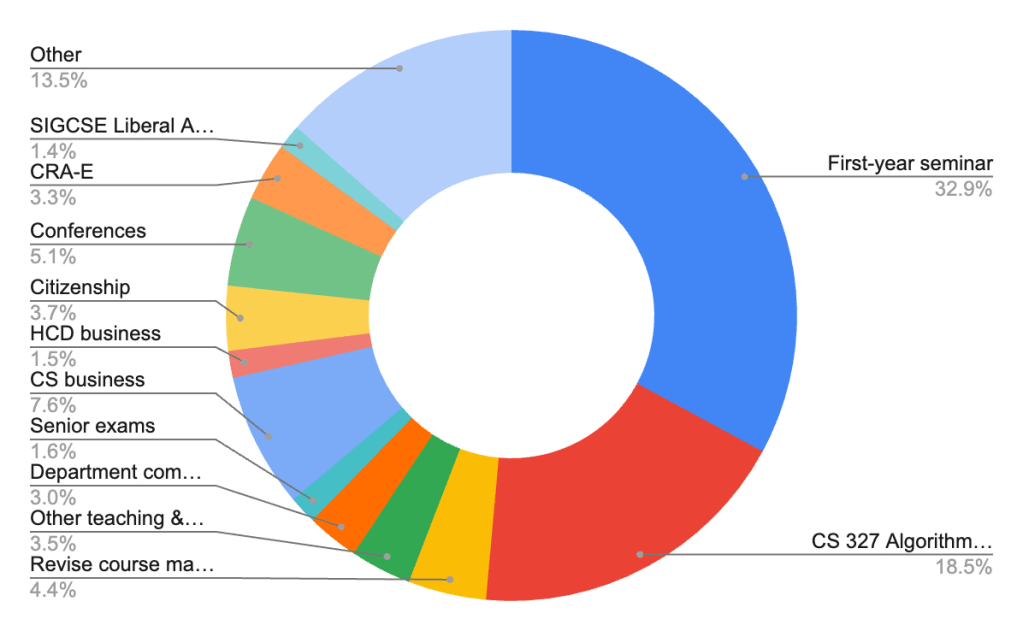
What stands out for is that I spent about half my time on my two courses. I spent about a third of my time (323 hours) just on First-Year Seminar, which I was teaching for the first time. I spent time planning before the semester started. Besides time in class, I spent time reading, planning lessons, and developing assignments. I spent a lot of time grading.
By contrast, Algorithms took much less time – 182 hours, or a bit more than half of the time I spent on First-Year Seminar. I was teaching Algorithms for the third time, so not much preparation was needed. Most of my time would have gone into lectures and oral homework presentations. (For details on the latter, see “Enhancing Faculty-Student Interaction in an Undergraduate Algorithms Course Through Group Oral Presentations” by my former colleague John Stratton).
But this wasn’t all the time I spent on teaching! I spent 34 hours on other teaching and advising – supervising independent studies, advising for fall course registration, and writing recommendation letters. I spent another 29 hours on department community – notably weekly CS Pizza meetings, a hackathon, and CS presentations at the Whitman Undergraduate Conference. I spent 16 hours on senior oral exams, a requirement for all majors at Whitman. Finally, I received a Pedagogical Inquiry Grant (PIG) to revise textbook materials for CS 220, Discrete Math & Functional Programming, so that they were in good shape for a colleague to use last fall. Over May and June, I spent about 40 hours on this project.
All told, I spent about two thirds of my time on teaching and related activities.
I did not serve on any elected committees during my last year at Whitman. However, as department chair, I spent about 75 hours on CS department business. I also served on the Human-Centered Design concentration committee, which took about 15 hours of my time, spread over biweekly meetings during the semester and a summer planning retreat. I spent about 36 hours on activities I would describe as institutional citizenship – attending faculty meetings, science division meetings, faculty research talks, and so on. So that’s another eighth of my time spent on institutional service.
I spent 36 hours attending conferences, specifically the SIGCSE Annual Technical Symposium on Computer Science Education in Pittsburgh that February and my first annual Cambridge Cybercrime Centre meeting.
I spent 32 hours on service to the CRA Education (CRA-E) committee. I also spent 14 hours with the SIGCSE Liberal Arts committee [link]. This is the work I would count as closest to scholarship.
Finally, I spent 133 hours, or about one-eighth of my recorded time, on “Other” – not just email, breaks, and daily planning, but all the aspects of my work that didn’t fit into any of the projects listed above.
The total is 982 hours over six months, or about 38 hours per week. Excluding about 4 weeks of vacation, travel to plan our move to Cambridge, other days my daughter was home from school, and time off for routine medical procedures, it comes out to more like 45 hours per week.
Spring 2026: King’s College, Cambridge
It’s harder to say what constitutes a typical day at King’s. It’s easier to talk about a weekly schedule for term time. Whenever possible, I spent Mondays and Fridays at the Computer Lab, where I have a desk in a shared office. Tuesdays, Wednesdays, and Thursdays I aimed to spend in College at King’s. (I think we say “in College” rather than “at College” because the colleges all have walls!)
Four days a week, I dropped Gwendolyn off at Breakfast Club – ideally around 8 am but sometimes not until 8:30. On Wednesdays, when Breakfast Club was already fully booked at the start of the school year, we had a standing breakfast date at Cafe Nero. If Brooks was home, I picked Gwendolyn up from school at 4:30 Tuesdays after Spanish Club, 3:20 Wednesdays in time for Ninja Knights, and 5:45 on Friday from Afterschool Club. If Brooks was traveling, I also picked her up from school at 3:20 on Mondays and Thursdays, with swimming lessons after school on Thursdays.
Why did I choose Mondays and Fridays to spend at the Computer Lab? Monday at 11 am is the weekly Cybercrime Centre status meeting; I renewed my weekly review habit by scheduling it for the morning hours. Friday at 11 is the weekly reading group, so Friday morning often found me reading. Afternoons varied depending on the week’s work, and sometimes saw me back at King’s for meetings (in person, or on Zoom in my private office). On Fridays when I had supervisions, I rarely made it to the Lab: meeting with students took all afternoon, and marking their work took all morning.
On Tuesdays and Thursdays I arrive in College around 8:45 am and eat breakfast before starting work. There was one Fellow I would chat with at breakfast fairly often, and others from time to time. I eat lunch at the Fellows’ Table nearly every day I work in College, rarely with the same people. Over time there got to be some familiar faces. If it was a day with supervisions, I spent the morning marking and the afternoon meeting with students. Otherwise, I focused on learning course material or doing other work.
During school breaks, all bets are off. I often work peripatetically near my daughter’s holiday activity – especially at the Cambridge Botanic Garden, which is lovely but has nowhere to plug in a laptop.
Finally, many weekday evenings, I have Zoom meetings with colleagues in the United States.
The pie chart below shows my time use from January 12 – my start date at King’s – through July 18 – the date of the last Congregation of Fellows of the 2025-6 academic year. (One of my lessons learned from this first year at King’s is that wrapping up the academic year extends a full month beyond the end of Easter Term.)
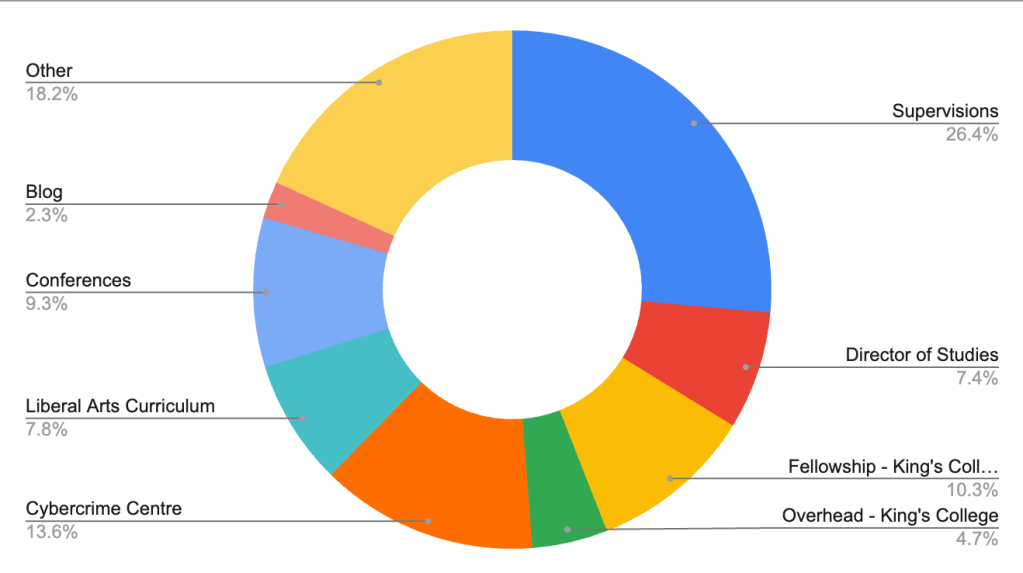
The 224 hours I spent on supervisions represents the entirety of my time spent on teaching – about a quarter of my time at King’s vs over half at Whitman. Time spent on supervisions includes about 50 hours of meetings with students, about as many hours marking student work, a few hours of training, several hours spent scheduling meetings and assignments, and over 100 hours spent studying materials for five different courses, which were to varying degrees all new to me.
I spent 62 hours on the teaching-adjacent activities determined by my role as Director of Studies. I spent about 16 hours meeting with my advisees – about four hours, or 30 minutes per student, at the beginning and end of each of Lent and Michaelmas terms. Since I was Director of Studies for the graduating Part II students, I attended the graduation lunch and dinner, as well as graduation itself. The rest of this time was spent in a variety of social, student support, and administrative activities.
I spent 87 hours acting as a Fellow of King’s College, independently of the responsibilities above. In this category I include some obligatory events – notably, my induction ceremony in January and four Congregations – but also social encounters with Fellows and their guests over formal High Table dinners (five times over the spring) as well as informal lunches and breakfasts (several times each week).
I recorded another 40 hours as “Overhead – King’s College.” This is mainly reading or responding to email that I can trace directly to my responsibilities at King’s, but that I did not account to one of the more specific categories listed above.
All told, I spent about half my time on responsibilities to King’s College – which is why I’ve been saying it’s a “part-time job.” However, my contract as a College Teaching Officer states, “You are also expected to pursue academic research during your employment.” Of course, this was also an obligation of my sabbatical from Whitman.
Outside of my responsibilities to King’s, I spent 51 hours attending the CHI conference in Barcelona, which was part of my original sabbatical plan. I also spent 115 hours with the Cambridge Cybercrime Centre. I joined in the Lent term master’s seminar, attended the aforementioned weekly status meetings, participated in the weekly reading group, and attended the annual conference. Unfortunately, this did not result in any new collaborations, but I learned a lot.
Instead, I doubled down my commitment to the scholarship of curriculum development, coming out of the SIGCSE Liberal Arts committee. I spent about 67 hours on this, as well as 28 hours attending the annual LACS meeting at Swarthmore.
Once I knew I would not be returning to Whitman, I felt obligated to resign from the CRA Education committee, as I would no longer have an affiliation to a North American academic institution. So I spent almost no time on service to that committee.
However, I spent about 20 hours blogging, after spending almost no time blogging during my last year at Whitman. (Dear reader, you might have noticed!)
Finally, I spent about 155 hours, or nearly 20% of my time, on “other” – a buffet of otherwise unaccounted for activities. This included the aforementioned weekly reviews, keeping up with my Whitman email, and moving work-related belongings (both physical and digital).
All told, I spent about 850 hours on work: just over 31 hours per week averaged over 27 weeks, or just over 35 hours per week when subtracting about three weeks of annual leave. This is why it feels like “semi-retirement” compared to my job at Whitman.
While teaching has contracted and scholarship has expanded, what’s missing? Institutional service, beyond what is expected of all Fellow. In particular, I missed King’s committee assignments in November, and I turned down an opportunity to take an administrative role.
Returning to where I started: I am about to publish this at 8 pm Mountain time, sitting on an airplane that is still boarding, with my laptop tethered to my phone. It’s been a summer of travel, and it’s not quite over yet. That will be my topic for next time.


Pingback: My Digital Move | Counting From Zero