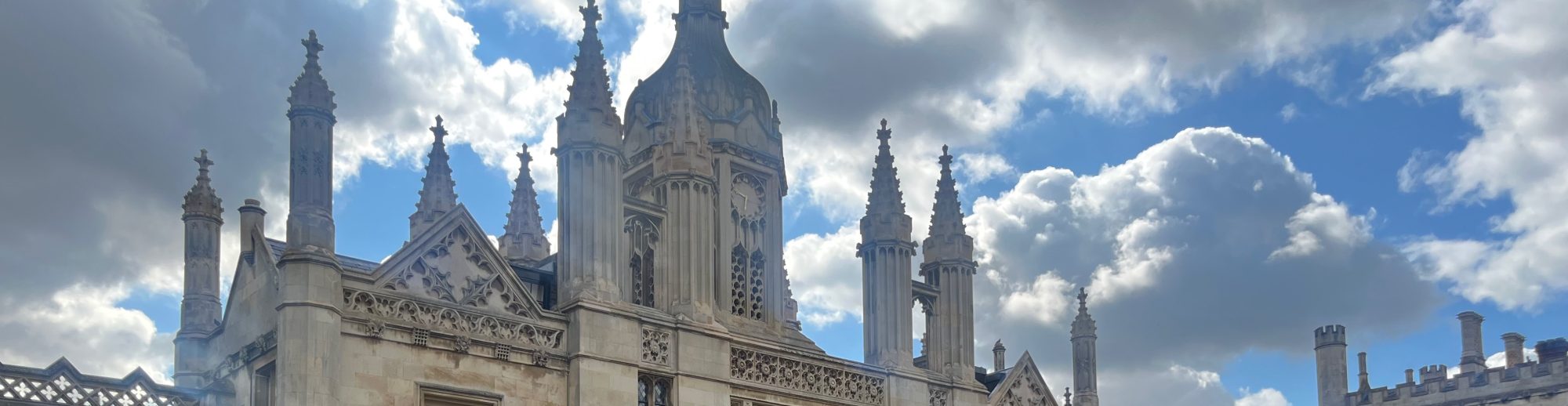
Similar to my prior faculty position at Whitman, my position as a College Teaching Officer at King’s is donor-supported. The difference is that Whitman’s CS positions are supported through endowments, while the King’s CS CTO position is supported by a current-use gift.
These are the instructions I was given for an 800-word benefactor report due at the end of July:
For this specific update I would need you to include your first impressions of life as a Fellow at King’s, highlight any collaborations that may have already started with other King’s or Cambridge academics, and share (as much as it is possible) your academic objectives. Links to any papers published are always helpful. It will serve as an introductory report so the donor knows you’ve settled in well.
And these are the 712 words I wrote:
My name is Janet Davis. After a 20 year career teaching at US liberal arts colleges, I joined King’s College as a CTO for computer science in January 2026.
In my role as a Supervisor and Director of Studies, I’ve gotten to know every King’s student in the CST Tripos. They are delightful – thoughtful, self-motivated, and of course very bright. My predecessor Api Hasthanasombat was immensely helpful in introducing me to his students and helping me understand my job responsibilities; every colleague I have had occasion to work with has been similarly helpful. This year I served as DoS for Part II students; I am excited to see where their careers beyond King’s will take them. As a supervisor, I enjoyed studying several subjects that are new to me – one of the intellectual pleasures of being a teacher – as well as learning the structure of a Cambridge education, which heretofore had been a mystery to me.
I was even able to connect my teaching with my professional curiosity. Throughout the academic year, I have joined in weekly meetings of the Cambridge Cybercrime Centre, with an eye towards possible collaborations. In the Michaelmas and Lent terms, I sat in on upper-level seminars in Cybercrime and Cybersecurity, both entirely new areas to me as my training is in human-computer interaction (HCI). In Easter term, I agreed at the last minute to supervise the Part IB Cybersecurity course, which has given me a foundation in what every computer scientist should know. The coursework also gives me key building blocks for a possible collaboration with Robert Watson in CST, developing new materials for undergraduate education about the CHERI secure architecture.
At Cambridge as at many universities, work on HCI and human-centered design is scattered across many departments. Alice Hutchings played a key role in introducing me to that elusive community; since joining King’s I’ve attended a half-dozen HCI events. In April, I attended the ACM SIGCHI conference on Human Factors in Computing Systems in Barcelona, where I met a number of old friends (it had been ten years since my last attendance) but also met several Cambridge researchers with whom I look forward to interacting further.
While my training is in HCI, over the past five years my research has moved increasingly towards computing education practice. I was able to attend the conference of that name in Durham this January, just before the start of my employment at King’s, and I also have been participating in the activities of the local Teaching & Learning Community of Practice, which is a possible venue for future presentations. While I have resigned my position on the Computing Research Association’s Education committee, as that organization is entirely based in North America, I have continued my participation in ACM activities and particularly those of the ACM SIGCSE Committee on Computing Education in Liberal Arts Colleges. I have continued to contribute to work on the MAP-CS project, providing a structured backward-design process for curriculum review and revision (NSF grant #2517969), including development of a Tutorial proposal for the 2027 SIGCSE Annual Technical Symposium and the 2026 SIGCSE Virtual conference. I have also picked up my involvement in the Essential Computing Concepts (ECC) project, developing a concise set of timeless, high-level learning outcomes for undergraduate computer science. I recently worked with three colleagues to propose a SIGCSE Virtual working group to further ratify and revise the ECC. Our proposal was accepted; we look forward to carrying out this work over the next year.
Returning to King’s, it has been a pleasure to join a community of scholars with such diverse interests and backgrounds and such deep care for undergraduate education. I appreciate King’s investment in food and drink as a social lubricant for the Fellowship: I’ve gotten to know many colleagues at breakfast or lunch in the Hall, and at High Table when I’m able to set aside my family responsibilities. In my career as a liberal arts college faculty member, I enjoyed working closely with colleagues across the arts and sciences; at King’s I’ve also enjoyed conversing with colleagues in law, medicine, and engineering. During my term based solely at the Computer Lab, I greatly missed these opportunities for stimulating and sometimes fruitful discussions across disciplines. I am looking forward to many more.
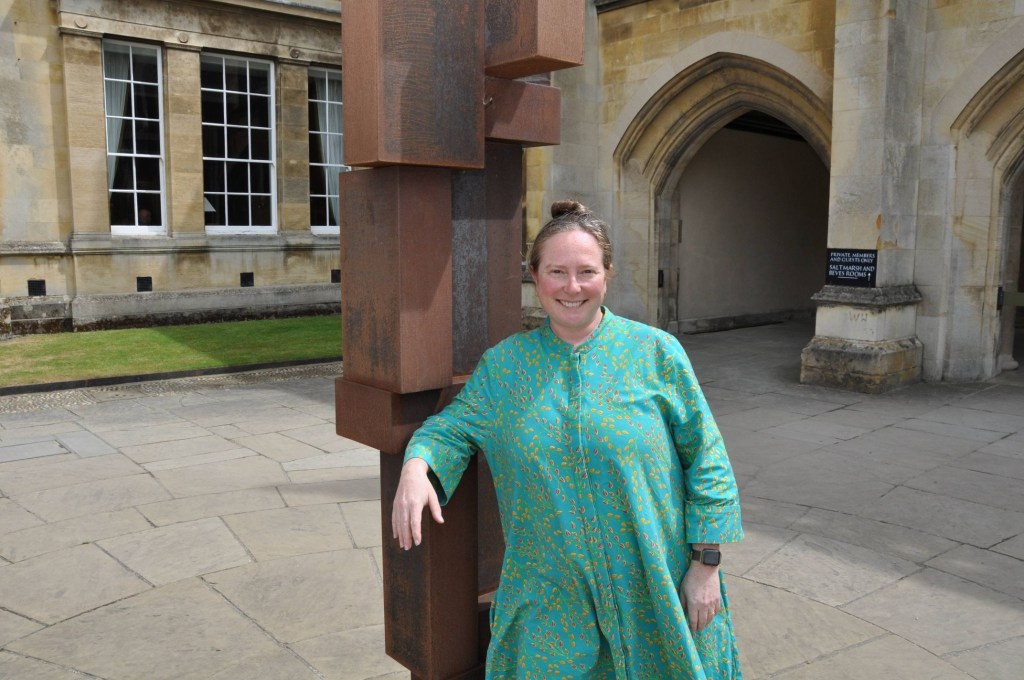
I still wear glasses, but the photographer asked me to take them off because they turn dark in the sun.
Reflections
I found two particularly valuable insights in writing my report:
- I really did meet and work with nearly every undergraduate CS student – 23 in total – during my first two terms at King’s. There were just two exceptions. After writing this, I learned of an undergraduate on intermission (leave of absence) who returned just in time for exams. And at the Graduation dinner, I was seated across from the one Part III (fourth-year integrated masters) student, who completed her thesis with honors. The proportion of all undergraduates who I got to know is actually higher than the proportion I would usually know in the CS major at Whitman – admittedly, a program with more than twice as many students.
- While there’s still HCI research that excites me, my energy is devoted to my collaborations around undergraduate CS curriculum. Rather than fighting it, I’m coming to realize I should accept and embrace it. Eventually I will circle back to the the HCI topics that excite me – or I won’t, and that’s okay. In the meantime, this is motivation to finally connect with the education group in the Computer Lab.
Coming next
Watch for my next post, comparing my responsibilities and time use in my first six months at King’s vs my last six months at Whitman. What questions do you have?


Thanks for posting this reflection! It’s been fascinating to follow your adventures this year.
My questions: how does your “typical day” differ at Kings from your “typical day” at Whitman? What’s surprised you the most about your new daily routine?
LikeLike
Janet!
Just found this blog, hope you’re well and have been able to stay cool during the heatwave!
Looking forward to reading more about your adventures 🙂
LikeLike
Pingback: Time use: King’s College vs Whitman | Counting From Zero
Pingback: Summer Travel | Counting From Zero
Pingback: My Digital Move | Counting From Zero